On January 17, 2025, we successfully organized the workshop “Restorative Practices in Education: Building Relational School Communities”, led by two speakers, James Lim and Sebastian Teo, from Lutheran Community Care Services (LCCS).
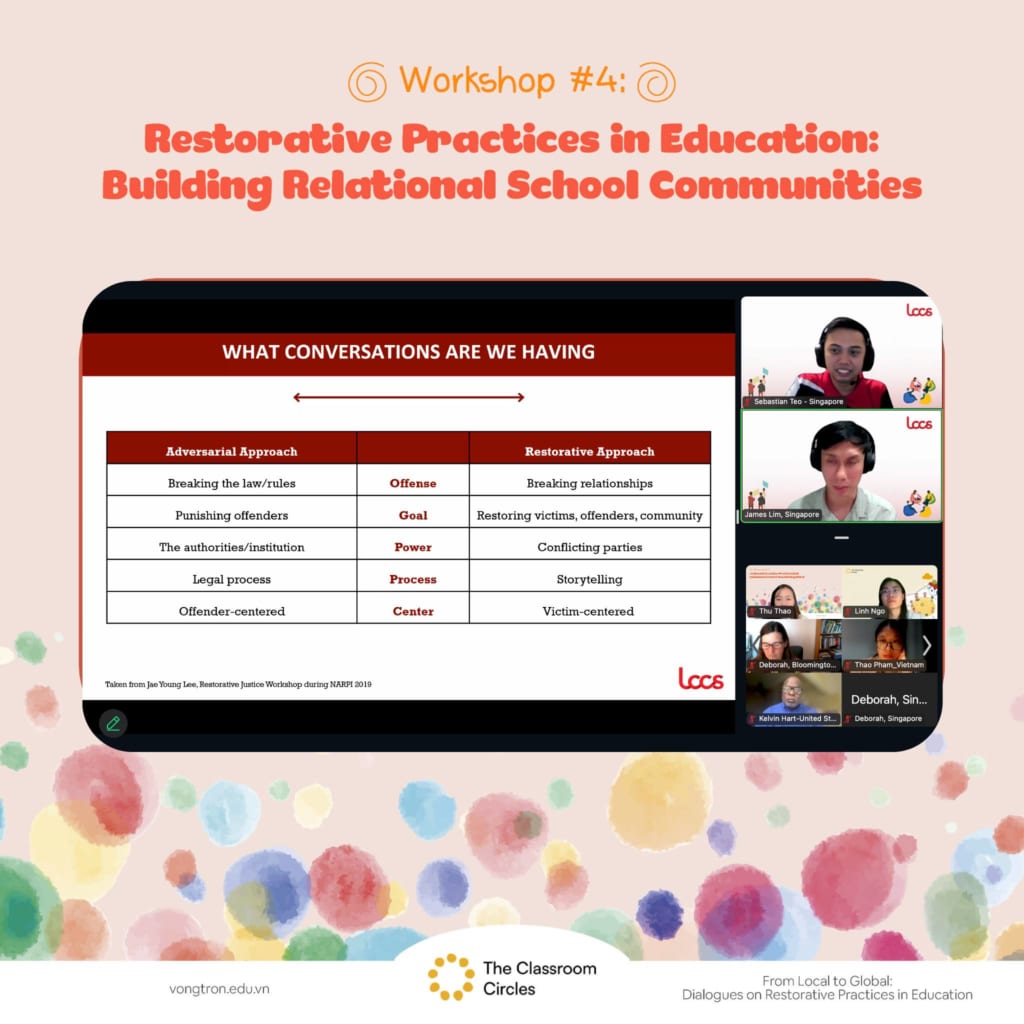
The discussion began with a real-life case handled by LCCS: Manfred, a five-year-old boy, was caught stealing from a store. Applying Restorative Practices, LCCS staff worked with Manfred, the store owner, his parents, and his school. Instead of facing punishment and blame, Manfred underwent a restorative process alongside his family, community members, and the store owner. This approach helped him understand his actions and actively participate in making amends. An interview recounting this case has been shared in the comments section. This story serves as a clear example of the contrast between the Adversarial Approach (conflict-based) and the Restorative Approach.
The discussion on restorative practices in education emphasized shifting away from rigid, punishment-focused methods toward approaches that preserve human dignity and strengthen community relationships. Traditional disciplinary methods often leave students feeling isolated, disconnected from the consequences of their actions, and unaware of how their behavior affects their personal growth. In contrast, restorative practices promote a more holistic and empathetic approach to conflict resolution and discipline. By involving all stakeholders in addressing harm within the community, these practices ensure a deeper, more meaningful resolution.
For example, in a restorative circle, a student who has harmed someone can engage in a dialogue where they listen to the emotional experiences of those affected. Of course, before students can fully participate in a restorative circle, foundational work must be done with them, their families, teachers, and other involved parties.
This is a long-term process, and at times, it may feel frustrating—especially when discussions seem to revolve around “talking and talking a lot” or when excessive time is spent resolving a single incident. However, with over 20 years of experience promoting restorative practices in communities, James shared a crucial insight: “Spend time now to save time later.” Investing time in properly addressing these issues now prevents more significant challenges in the future.
Building a strong foundation requires trust and harmony through practices that encourage students and teachers to express themselves equally in the classroom. One familiar technique for teachers is the use of “I statements” to express emotions, thoughts, and desired actions from others. This method fosters constructive dialogue in the classroom, enhancing students’ sense of responsibility while creating a space for emotional and cognitive growth.
Ultimately, restorative practices aim to strengthen school communities by transforming discipline into an opportunity for personal and social growth, rather than mere punishment.
Stay tuned for our “Let’s Talk” series, where we compile questions and answers from our workshops. This is an ongoing journey, and we look forward to continuing these discussions in the future!